
 Myanmar
 English
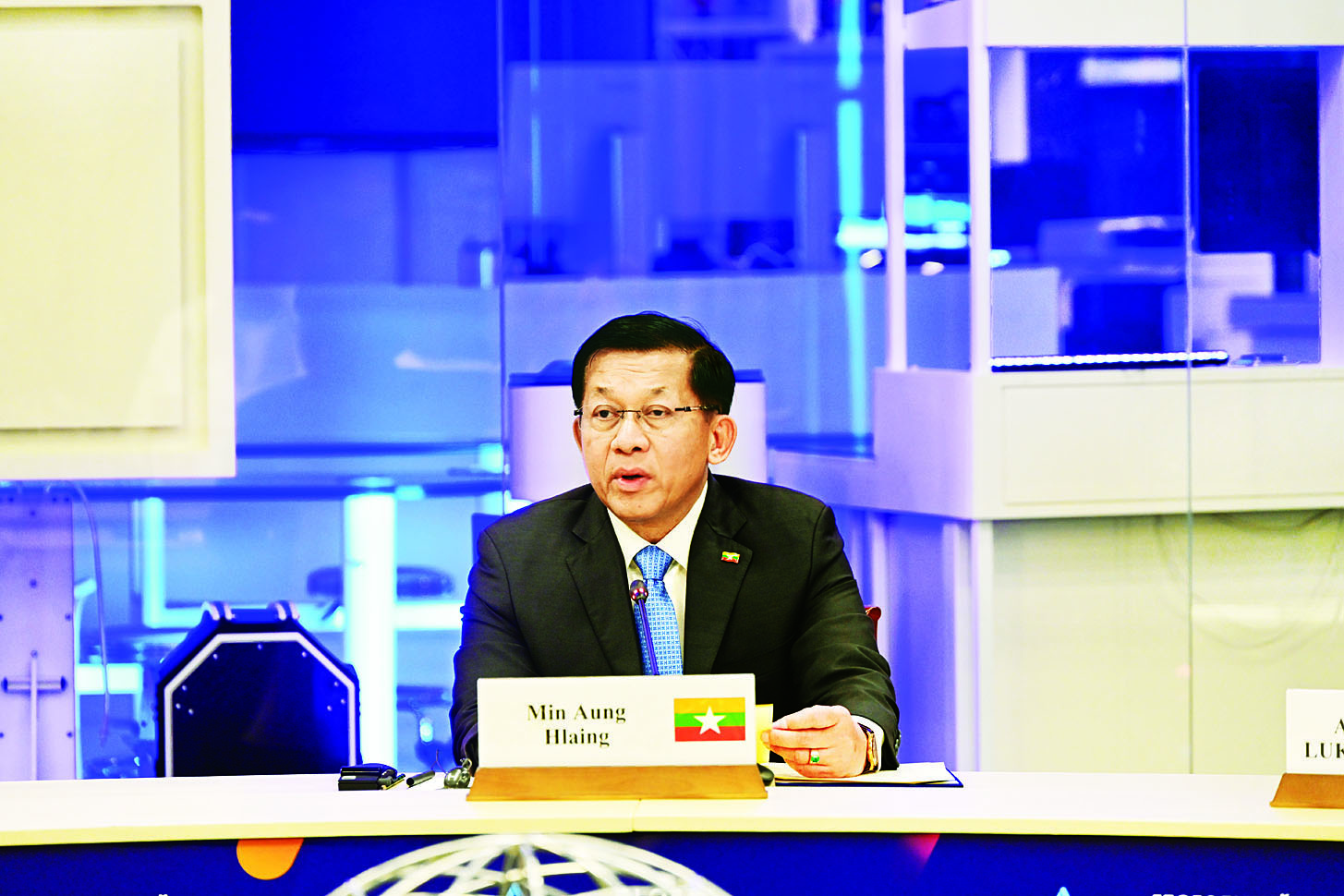

Acting President and SSPC Chairman of the Republic of the Union of Myanmar Senior General Min Aung Hlaing attends the plenary summit of the World Atomic Week Forum 2025 in Moscow of the Russian Federation
Nay Pyi Taw September 25
Acting President of the Republic of the Union of Myanmar, Chairman of the State Security and Peace Commission of the Republic of the Union of Myanmar Senior General Min Aung Hlaing participated in the Plenary Summit of the World Atomic Week Forum 2025 with the title of “From a New Technological Rollout to a New Worldview” at the Atom Museum in Moscow of the Russian Federation today.
The “World Atomic Week Forum 2025” was attended by international leaders including the President of the Russian Federation, the high-level Myanmar delegation led by the Acting President of the Republic of the Union of Myanmar and Chairman of the State Security and Peace Commission of the Republic of the Union of Myanmar, the Prime Minister of Armenia, and the President of Belarus, as well as senior government officials and heads of nuclear energy organizations, world-class experts, executives of major companies, leaders from the CIS, Asia, Africa, and Latin America, and delegates from 105 countries.
First, the Acting President of the Republic of the Union of Myanmar and Chairman of the State Security and Peace Commission of the Republic of the Union of Myanmar, together with international leaders, senior government officials, and other attendees, were welcomed by Mr. Alexey Likhachev, Director General of the ROSATOM of the Russian Federation, and responsible officials.
At the ceremony, Mr. Alexey Likhachev, Director General of the ROSATOM made an opening speech whereas the President of the Russian Federation delivered an opening address.
After that, speeches were delivered by the President of Belarus, the Prime Minister of Armenia, the Acting President of the Republic of the Union of Myanmar and Chairman of the State Security and Peace Commission of the Republic of the Union of Myanmar, the Prime Minister of the Federal Democratic Republic of Ethiopia, and the Director General of the IAEA, as well as senior government officials from various countries, heads of nuclear energy organizations, and world-class experts in attendance.
In his speech, the Senior General said that that this international forum, the World Atomic Week, held in connection with the 80th Anniversary of Russia’s nuclear industry, not only high-lights the history of how nuclear energy and nuclear technology have contributed to meeting global energy needs and supporting agriculture, medicine, and industry, but also serves as a platform to share and discuss positive goals for the future of the nuclear sector.
He added that, in line with the forum’s motto, “Everything starts with an atom,” all matter in the vast universe, including ourselves, is composed of atoms.
As you all know, the ability to harness and control the immense nuclear power within the atom’s nucleus has not only enabled the generation of electricity but has also greatly advanced medicine, agriculture, and industry. The Russian Federation, beginning on 26 June 1954 during the Soviet era, was the first country in the world to produce and distribute electricity from nuclear energy. At present, Russia is also the only nation that can successfully operate fast breeder reactors capable of generating new fuel.
Over the past 80 years, the nuclear sector of the Russian Federation has been steadfastly transformed into a strong pillar of knowledge, innovation, and peaceful nuclear science development. I wish to extend my heartfelt praise and tribute to all the scientists, engineers, policymakers, and visionaries who have contributed to this remarkable achievement.
Global energy demand is increasing annually, and according to the report of the International Energy Agency (IEA), by 2025 it is projected to rise by 2.2 percent compared to 2024. At present, about 9 percent of global energy needs are being met by nuclear power. Under the World Net-Zero Carbon Emissions initiative, plans are being implemented to use renewable energy in combination with nuclear power. Nuclear energy is recognized as a form of green energy with low car-bon emissions and the ability to provide stable electricity supply.
In addition, nuclear technologies in agriculture help support safer food production that is more resilient to climate change impacts. Programs such as genetic crop mutation breeding have produced crops that are resistant to drought, pests, and diseases. Likewise, sterile insect techniques have reduced the need for pesticides, helped protect ecosystems, and contributed to sustainable long-term harvests. For agriculture-based countries like ours, these advan-cements provide significant benefits.
In the field of medicine, radioisotopes and nuclear imaging technologies have transformed methods of disease detection and treatment. Early diagnosis of cancers, along with targeted therapies through radiotherapy, have saved millions of lives each year and greatly improved the quality of life for countless people. Nuclear medicine thus stands as a prime example of how the power of science can serve humanity.
While the peaceful use of nuclear energy across various sectors brings great benefits to humankind, there are also challenges. It is essential to properly manage radioactive waste to avoid harming natural ecosystems, to prevent radiation leaks from nuclear materials, and to ensure reliable safety systems that can avert nuclear accidents.
Myanmar, in its efforts to utilize nuclear energy, has since 2022 signed memorandums of understanding on cooperation with the Russian Federation and the State Atomic Energy Corporation (ROSATOM). This marked the beginning of laying the foundation for the country’s nuclear energy development.
In February 2023, a Nuclear Technology Information Centre was opened in Yangon. Through this initiative, greater public and media awareness and under-standing of Russia’s extensive experience and advanced expertise in nuclear industries and technologies has been promoted.
In addition, Terms of Reference (ToR) for cooperation in developing national-level nuclear infrastructure were signed between the Russian Federation and Myanmar’s Ministry of Science and Technology. Furthermore, in collaboration with the Russian Federation and ROSATOM, the Ministry of Science and Technology organized Science Fair 2023 and Science Fair 2024 at the Nuclear Technology Information Center and Yangon Technological University (YTU). These events provided Myanmar students with extensive knowledge and understanding of nuclear technology.
Through the scholarship program offered by ROSATOM, collaboration is underway for the continuous development of human resources required for nuclear energy and nuclear technology, including the work requirements for Small Modular Reactors (SMRs).
In implementing its nuclear energy program, the Republic of the Union of Myanmar is working according to ROSATOM’s timeline, in line with the guide-lines of the International Atomic Energy Agency (IAEA), with three milestones and three phases. Myanmar has been a member state of the IAEA since 1957 and has participated in its Technical Cooperation programs. The IAEA has provided project funding, supplied equipment, improved infrastructure, and collaborated by including Myanmar in technical cooperation programs for human resource development, providing technical training, and implementing technical cooperation projects.
In 2024, Myanmar attended a nuclear law workshop convened by the IAEA and is currently revising and drafting Myanmar’s nuclear law for implementation.
In 2025, representatives from 18 countries, including Myanmar, attended a regional cooperation training on the placement of small nuclear power plants, which is part of the implementation of national-level nuclear programs. The training was led by the ROSATOM Technical Academy and the IAEA for foreign experts. Although Myanmar, as an IAEA member state, has been striving for many years to utilize nuclear technology in various fields within the country, progress had been slow for various reasons. However, since starting collaboration with Russia in 2022, significant progress has been made due to the accelerated efforts and Russia’s multi-faceted support.
As nuclear energy is a green energy source with low carbon emissions, Myanmar aims to obtain stable electricity from nuclear power to develop the national economy.
Myanmar has high electricity demands and is striving to supply power for small-scale industries and rural populations. Further-more, efforts will be made to further develop the health, agriculture, and industrial sectors using nuclear technology. To ensure the continuous development of human resources, Memoranda of Understanding have been signed for educational cooperation between universities in Russia and Myanmar, and plans are being implemented.
As an initial step, Myanmar is closely collaborating with ROSA-TOM to build a small nuclear power plant in the country and expresses its desire to cooperate with the Russian Federation to expand the necessary infra-structure and other various sectors.
I earnestly request that the Russian Federation and RO-SATOM continue to assist Myanmar to the best of their ability in establishing the necessary nuclear infrastructure, human resources, and other required tasks for building a small nuclear power plant in Myanmar.
Similarly, I also earnestly request that the International Atomic Energy Agency (IAEA) continue to assist in human resource development for Myanmar’s implementation of nuclear energy.
The Republic of the Union of Myanmar also wishes to cooperate with the countries attending this international forum, the World Atomic Week, in appropriate sectors related to nuclear technology. I invite you to enhance partnerships and cooperation with the Republic of the Union of Myanmar and offer my best wishes for nuclear energy to contribute to the peaceful, prosperous, and developed world for all people.
The “World Atomic Week Forum 2025” is being organized by Rosatom to mark the 80th Anniversary of Russia’s domestic nuclear industry. Aimed at promoting the peaceful applications of nuclear technology worldwide, the forum will be held from today, September 25 to September 28. The forum’s agenda will be attended by leaders from countries implementing nuclear programs, top global experts, heads of major companies, leaders from CIS, Asia, Africa, and Latin America, and representatives from 105 countries. Discussions will cover clean energy, advanced medicine, a healthy environment, industrial innovation, ecology, digital technology, logistics, and scientific educational topics. From September 27 to 28, youth programs will be prioritized, and the “Knowledge. First” competition, a science and education dissemination fund competition led by the Russian Knowledge Society, will be held, functioning as an international discussion platform.
- Log in to post comments